Case arises from an infringement notice for offence under land transport rule
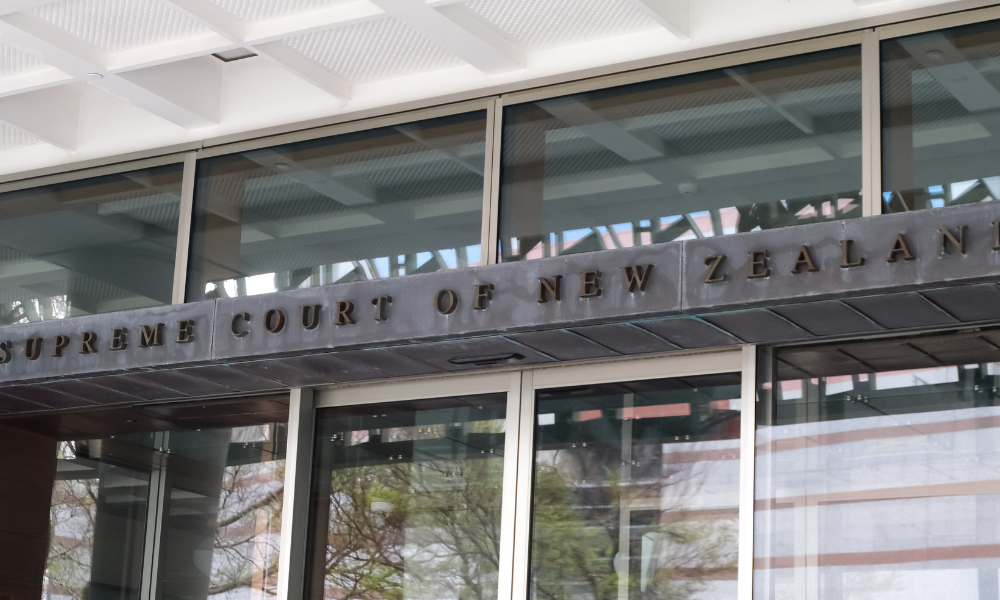
New Zealand’s Supreme Court has affirmed the New Zealand Court of Appeal’s decision determining that certain communications relating to a land transport infringement notice neither defamed the applicant nor harmed his reputation in a more than minor way.
In McConnor v Auckland Transport, [2025] NZSC 97, somebody drove a vehicle registered in the applicant’s name on a bus lane on an Auckland road on 15 October 2022.
Auckland Transport, the first respondent in this case, issued the applicant an infringement notice for an offence under the Land Transport (Road User) Rule 2004.
On 25 December 2022, Auckland Transport electronically referred the infringement fee to Baycorp (NZ) Ltd, its debt collection agent and the second respondent in this case.
On 31 March 2023, Auckland Transport adhered to the process in s 21 of the Summary Proceedings Act 1957 and initiated proceedings regarding the alleged infringement in New Zealand’s District Court via automated electronic means.
The applicant applied for summary judgment for a defamation claim he brought against the respondents. He claimed that two communications — specifically, Auckland Transport’s electronic referral to Baycorp and its commencement of s 21 proceedings — defamed him.
An associate judge of New Zealand’s High Court rejected the applicant’s summary judgment application and struck out his defamation claim.
The applicant appealed and applied for a waiver of security for costs – fixed at $14,120 – in connection with his appeal.
The deputy registrar refused the requested waiver. The applicant applied for a review of the deputy registrar’s decision.
A judge of the New Zealand Court of Appeal upheld the refusal of a waiver based on lack of merit and public interest in pursuing the claim. The appeal court judge found that neither communication defamed the applicant nor harmed his reputation in a major way.
The applicant sought leave to appeal the appeal court’s decision. He alleged that the associate judge lacked the jurisdiction to preside over defamation proceedings and acted beyond his authority in exercising that jurisdiction.
The Supreme Court of New Zealand dismissed the application for leave to appeal upon finding that the respondents should have the protection of security for costs. It ordered the applicant to pay the respondents one set of costs of $2,500.
The Supreme Court saw no apparent miscarriage of justice in the civil context, no question of general or public importance, and no sufficient prospects of success in the proposed appeal.
The Supreme Court said the appeal court applied the settled approach in Reekie v Attorney-General, [2014] NZSC 63, [2014] 1 NZLR 737. The Supreme Court added that the proposed appeal would involve the application of settled principles to the facts.
The Supreme Court accepted that the appeal court judge did not specifically address the jurisdictional argument. However, the Supreme Court noted that the deputy registrar addressed that argument.
Next, the Supreme Court considered the applicant’s claim that the associate judge lacked jurisdiction to determine the defamation proceedings. The Supreme Court found that the Defamation Act 1992 did not prevent an associate judge from presiding over such proceedings.
Lastly, the Supreme Court noted that, in the Senior Courts Act 2016: