Maurice Blackburn’s Class Actions & Corporate Conduct Symposium returns in Melbourne
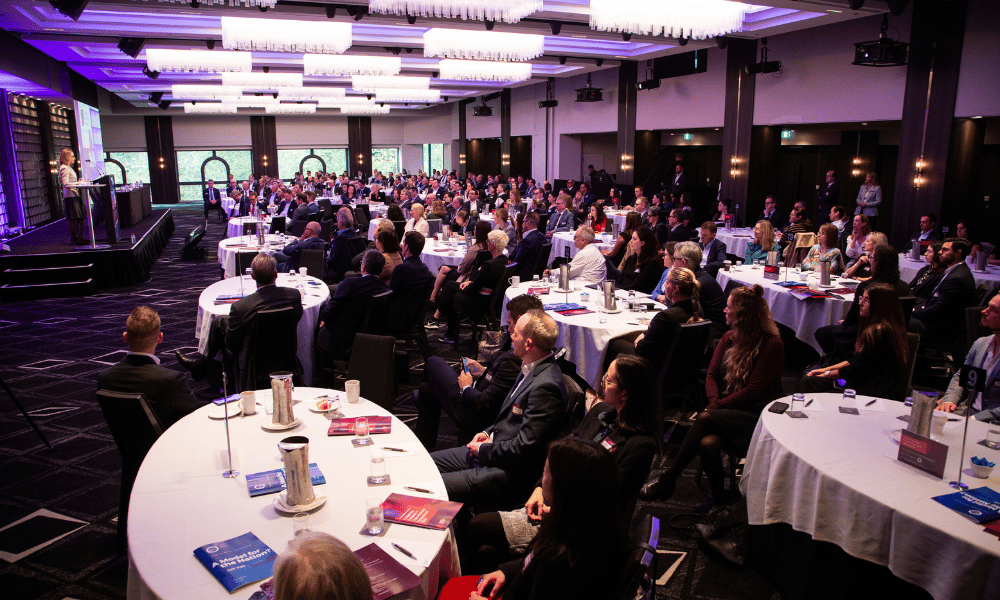
Against a backdrop of rapid technological change, intensifying scrutiny of corporate conduct, and evolving jurisprudence that will shape access to justice for years to come, Maurice Blackburn Lawyers’ Class Actions & Corporate Conduct Symposium returns in May 2026 as a timely and influential forum for discussion across the profession.
Event details:
Wednesday, 20 May 2026
1:00pm-5:00pm
RACV City Club
Level 17, 501 Bourke St, Melbourne VIC
Australasian Lawyer readers can save $100 with code AUSLAWYER100
The symposium brings together plaintiff and defendant lawyers, barristers, institutional investors, litigation funders, academics, policymakers, government and corporate representatives, reflecting the reality that class actions sit at the intersection of law, markets, regulation and public confidence.
This year’s iteration arrives at a particularly significant moment. The symposium opens with a keynote address from Federal Attorney‑General Michelle Rowland, and also features guest speakers including Chief Justice of the Supreme Court of Victoria, the Honourable Richard Niall, and the Federal Court’s Justice Nicholas Owens, among others.
Few developments have been as transformative in recent years as the Group Costs Order (GCO) regime in the Supreme Court of Victoria. Its introduction altered long‑standing assumptions about how class actions are funded, how risk is allocated, and how courts can balance commercial reality with public interest litigation.
As cases progress, attention is increasingly turning to the lessons of the Victorian experience — and the implications for whether similar mechanisms could or should be adopted federally or in other jurisdictions such as New South Wales. At the heart of this discussion lies a broader question: how courts can continue to manage complex litigation fairly, efficiently and transparently in an environment of increasing scale and sophistication.
The symposium’s legal practitioners’ panel, drawing on judicial and practitioner perspectives, is expected to explore these issues alongside the growing influence of technology and AI in litigation, including what that means for court processes, evidence management and procedural fairness.
Shareholder class actions and private enforcement
If class actions are a mechanism of access to justice, shareholder claims are a form of private regulation — one that complements public enforcement and underpins confidence in Australia’s markets.
That reality has rarely been clearer than in recent developments before the courts. The landmark judgment in the Brambles shareholder class action — the first time plaintiffs have succeeded at trial in an Australian continuous disclosure claim — represents a watershed moment. It has re‑shaped assumptions about what is practically achievable, and reinforced the role of class actions in holding listed entities to account where regulatory action alone may not deliver individual compensation.
Likewise, the Commonwealth Bank shareholder appeal to the High Court will also have significance the viability of shareholder class actions and, by extension, the balance between corporate disclosure obligations and accountability.
These are not abstract legal debates. They go directly to whether investors — particularly retail and superannuation fund members — can realistically vindicate their rights, and whether market integrity can be maintained through private enforcement when systemic failures occur.
Big tech, competition law and accountability
Layered onto this landscape is the rise of big tech — global, data‑driven corporations whose scale, reach and business models challenge traditional regulatory frameworks.
Across jurisdictions, competition and consumer law class actions are increasingly being used as tools to test conduct, redress harm and set boundaries for market behaviour. Australia is no exception. As technology continues to outpace legislation, litigation has become one of the few mechanisms capable of adapting in real time.
Drawing on insights from speakers including Edward Santow, Lizzie O’Shea, and Ricky Sutton, the symposium will explore how class actions — particularly in competition law — are being used to confront these challenges.
A forum for ideas that shape the system
With leading class actions lawyers including Rebecca Gilsenan, Miranda Nagy and Ronald Koo joining the program, discussions will be grounded in practical experience across securities, consumer, competition and public interest class actions.
As Australia’s class action regime continues to evolve — tested by courts, shaped by legislation and challenged by new forms of corporate power — the conversations held in forums like this will influence not just how cases are run, but who ultimately benefits from the law’s protection.