Canadian lawyers’ group condemns escalating US sanctions against court of last resort
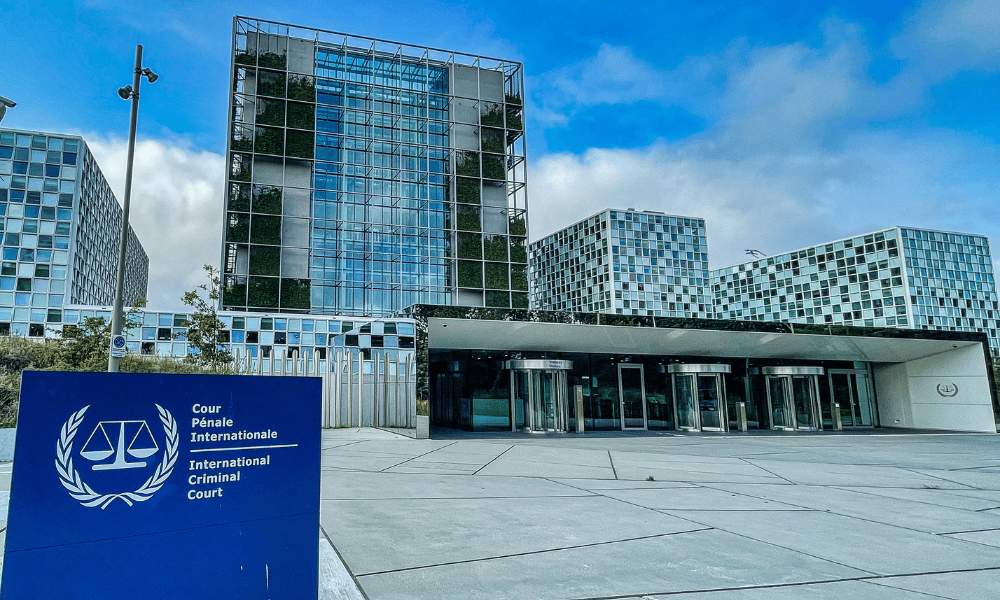
Lawyers’ Rights Watch Canada (LRWC) encouraged the federal government to take urgent and concrete steps to safeguard the International Criminal Court (ICC) amid the US administration’s sanctions issued last Oct. 9, in line with US President Donald Trump’s Executive Order 14203 dated Feb. 7, 2025.
In an Oct. 14 letter written by LRWC co-chairs Joey Doyle and Heather Neun and United Nations (UN) main representative Catherine Morris, LRWC condemned the steps depriving the ICC of US-based financial, technical, and other services and giving US organizations and individuals six months to wind down and cease their contracts and other activities with the ICC.
In the letter addressed to Mark Carney, Canada’s prime minister, Sean Fraser, federal attorney general and justice minister, and Anita Anand, Canada’s foreign affairs minister, LRWC urged the Canadian government to:
“Contemplation of further delay in applying Canada’s blocking statute would be unconscionable given the already existing and severe harmful impacts on the Court, and are tantamount to ‘civil death’ for judges, court officials, human rights lawyers and defenders being unlawfully punished without due process merely for their work fulfilling their lawful mandates and upholding international law,” the letter stated.
In an Oct. 9 joint statement, the foreign ministers of Canada, Denmark, Germany, France, Italy, Japan, the Netherlands, and the UK confirmed their “continued and unwavering support for the independence, impartiality, and integrity of the ICC” and committed to “constructive and inclusive dialogue with non-States Parties.”
While welcoming the foreign ministers’ opposition to the US sanctions, LRWC pointed out that the joint statement called for no action beyond dialogue.
“While diplomacy is essential to persuade the US to withdraw its attacks against the Court, concrete measures to protect the Court and those who are sanctioned must be implemented immediately,” LRWC’s letter stated.
“The stated aim of the US campaign against the Court is to shield US nationals and allies from ICC investigation and prosecution, falsely claiming that the ICC overrides US laws,” LRWC’s letter said.
LRWC noted that the current US administration previously issued sanctions against 14 ICC judges, prosecutors, and senior staff; a UN Human Rights Council-appointed independent expert; and several non-governmental organizations (NGOs) working with the ICC.
“Canadian ICC Judge Kimberly Prost is included among those who have been sanctioned without due process, for merely performing their mandated work,” the letter stated. “These actions aimed at dismantling the ICC are an attack on international human rights law and the rule of law.”
According to LRWC, the US administration’s campaign against the ICC also included:
“The US actions aimed at dismantling the ICC are an attack on well-established international human rights law, the rule of law, and the sovereign right of every State to be a Party to the Rome Statute if they choose,” the letter said.
In its letter, LRWC highlighted the following consequences of the US sanctions:
Here are some other recent news stories involving the ICC.
After a closed-door vote by the Assembly of States Parties last July, ICC member states removed chief prosecutor Karim Khan from his position in the context of sexual misconduct claims.
In August 2025, the US administration added to existing sanctions against ICC judges and officials, a move lamented by the International Bar Association as going against the global rule of law.
Enjoy this story? Read the latest international law news on the main page!