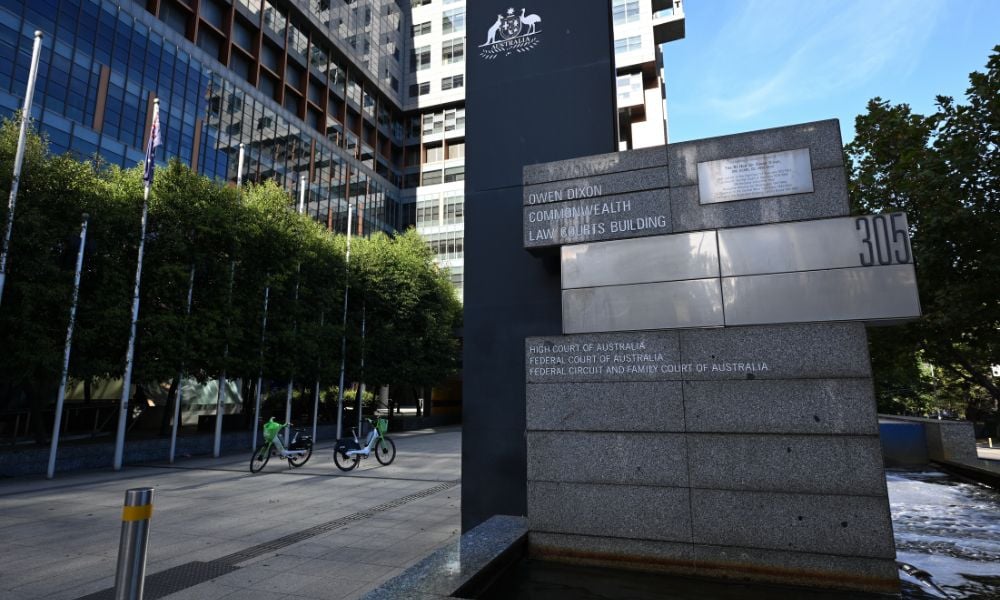
A NSW District Court ruling has for the first time in Australian legal history applied criminal law to a squatter's rights dispute, with significant implications for property lawyers

A Sydney solicitor's wife and son have been convicted of fraud after a court found they made false statements in statutory declarations to obtain title to a Glebe property that sold in 2022 for $3.67 million, in what their defence lawyer has described as an unprecedented intersection of adverse possession law and the criminal code.
The case, decided in the NSW District Court by Judge Alister Abadee, centred on a rundown inner-west terrace whose owner, Ansis Neilands, died in 1995 leaving behind an informal will naming a Florida-based sister as beneficiary. When she could not be located despite years of searching - including enquiries with the US Embassy - the property fell into legal limbo.
Margaret Colquhoun and her son Andrew were convicted of dishonestly obtaining the property by deception. Her husband Peter Colquhoun, principal of Rozelle firm Colquhoun & Colquhoun, was acquitted after the court found he was not party to a joint criminal enterprise. The Crown did not allege Peter personally made any false statements.
The property was renovated and eventually sold in 2022 for $3.67 million. Margaret and Andrew remain on bail ahead of a sentencing hearing on 3 August.
Under the doctrine of adverse possession - colloquially known as squatter's rights - a person who occupies land continuously for at least 12 years, openly and without the owner's consent, may apply for registered title under the Real Property Act 1900 (NSW) and the Limitation Act 1969 (NSW). Applications are made by statutory declaration to NSW Land Registry Services and are technically demanding.
The Colquhouns' first application in November 2013 declared that Margaret and Andrew had jointly been "in possession" of the Glebe property since 1 November 2000, and that it had "appeared abandoned" at that date. A concurrent declaration by Andrew echoed those assertions.
The difficulty was that the property was tenanted at that point - let at a reduced rate because of its poor condition - and it was not until 2003 that Margaret began to act as owner, appointing a rental agent and undertaking renovations. Andrew and his partner moved in around October 2010. That put their genuine period of possession short of the 12-year threshold needed to support a claim in 2013.
Judge Abadee found that both Margaret and Andrew had "engaged in multiple deceptions in documents" between 2013 and 2015, and that those deceptions "expedited the obtaining of the property" near the end of the 12-year limitation period.
Sydney solicitor Greg Walsh, who acted for all three accused, said the case broke new legal ground. "As far as I understand, this is the first time in Australia's jurisprudence that the criminal law has been invoked to deal with adverse possession," he said. He described his clients as people whose lives had been effectively destroyed by the proceedings, and characterised adverse possession as "a very complex matter."
For practitioners, the case carries a pointed message: false statements in statutory declarations lodged with Land Registry Services can attract criminal liability, not just rejection of a title application. Under section 192E of the Crimes Act 1900(NSW), dishonestly obtaining property by deception carries a maximum penalty of 10 years' imprisonment.
The facts also highlight the legal exposure that can arise from estates with missing beneficiaries. A property left unmanaged for years after its owner's death ultimately drew not just a civil claim but a criminal prosecution reaching the District Court.
Margaret and Andrew Colquhoun have not yet indicated whether they will appeal.