

Jump to winners | Jump to methodology
The best young lawyers in Australia and New Zealand have proved their value through two key attributes:
adaptability
awareness
As a group, they’re expected to do more now than a decade ago, including taking responsibility for outcomes, communicating clearly and understanding that clients are buying solutions, not legal theory.
“The lawyers who succeed now are not just technically good – they are strategic, self-led and commercially aware much earlier in their career,” says Adele Anthony, director of Adele M. Anthony Legal.
Australasian Lawyer and NZ Lawyer’s Future Legal Leaders 2026 were selected following an analysis of recommendations from managers and senior industry professionals. A common profile of strengths among the younger generation of top lawyers is something Anthony sees across the industry:
💻Tech fluency – they are faster, more efficient and open to new systems
🔍Curiosity – they question process and look for better ways
🤝Emotional intelligence – particularly in client-facing environments
⚖️ Values awareness – they care about culture, purpose and balance
📚Willingness to learn quickly – when given the right environment
🌿Aware that a legal career is not just about endurance – it’s about sustainability
“Compared to 10 years ago, today’s rising stars are sharper, faster and more self-aware, but they are also navigating a more complex environment,” explains Anthony. “Ten years ago, progression was slower but often more stable. Today, progression can be faster but only for those who learn to think, not just do.”
Mental health remains a critical issue, not because young lawyers are unaware of it, but because the supports currently available are largely conceptual rather than practical.

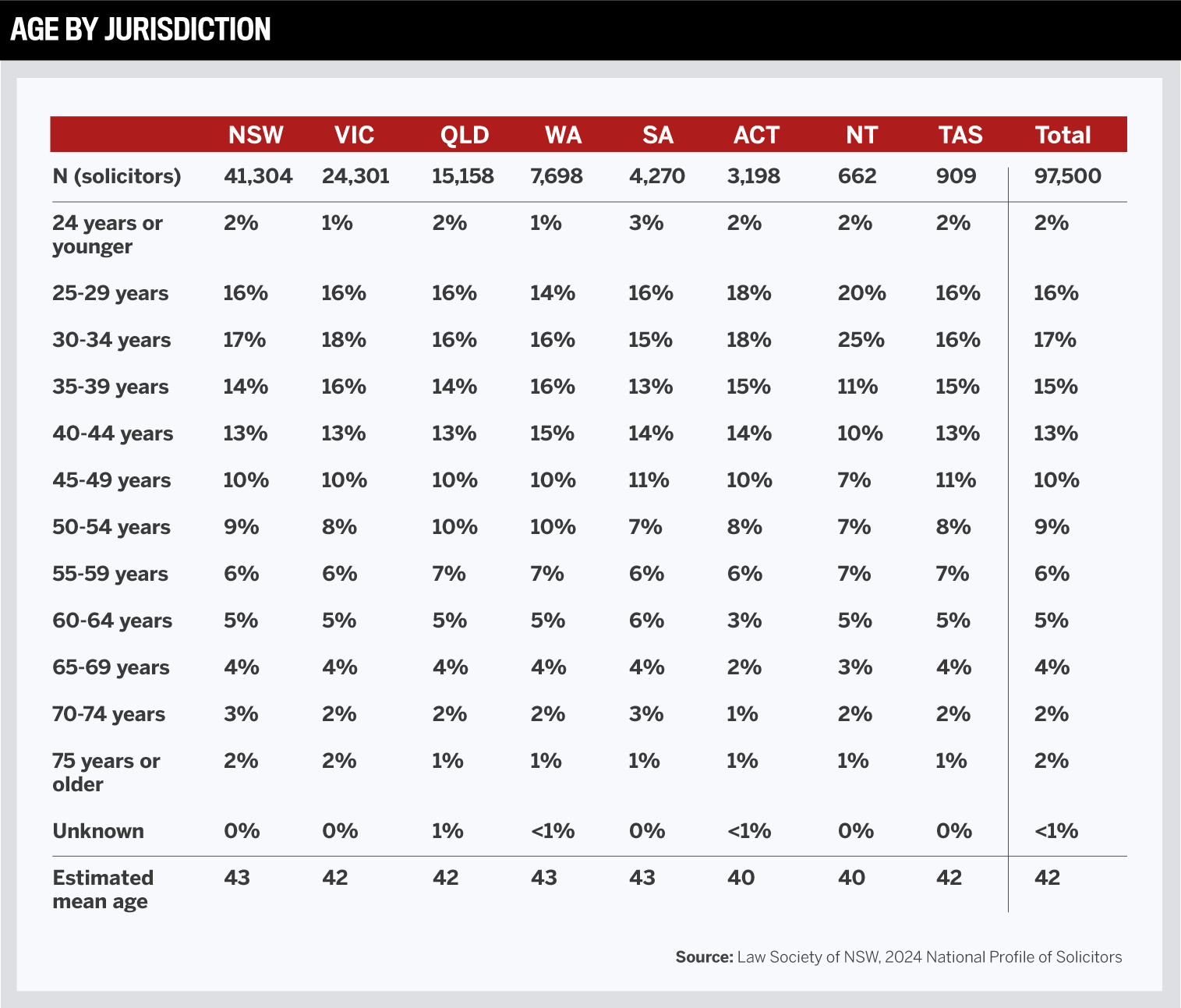
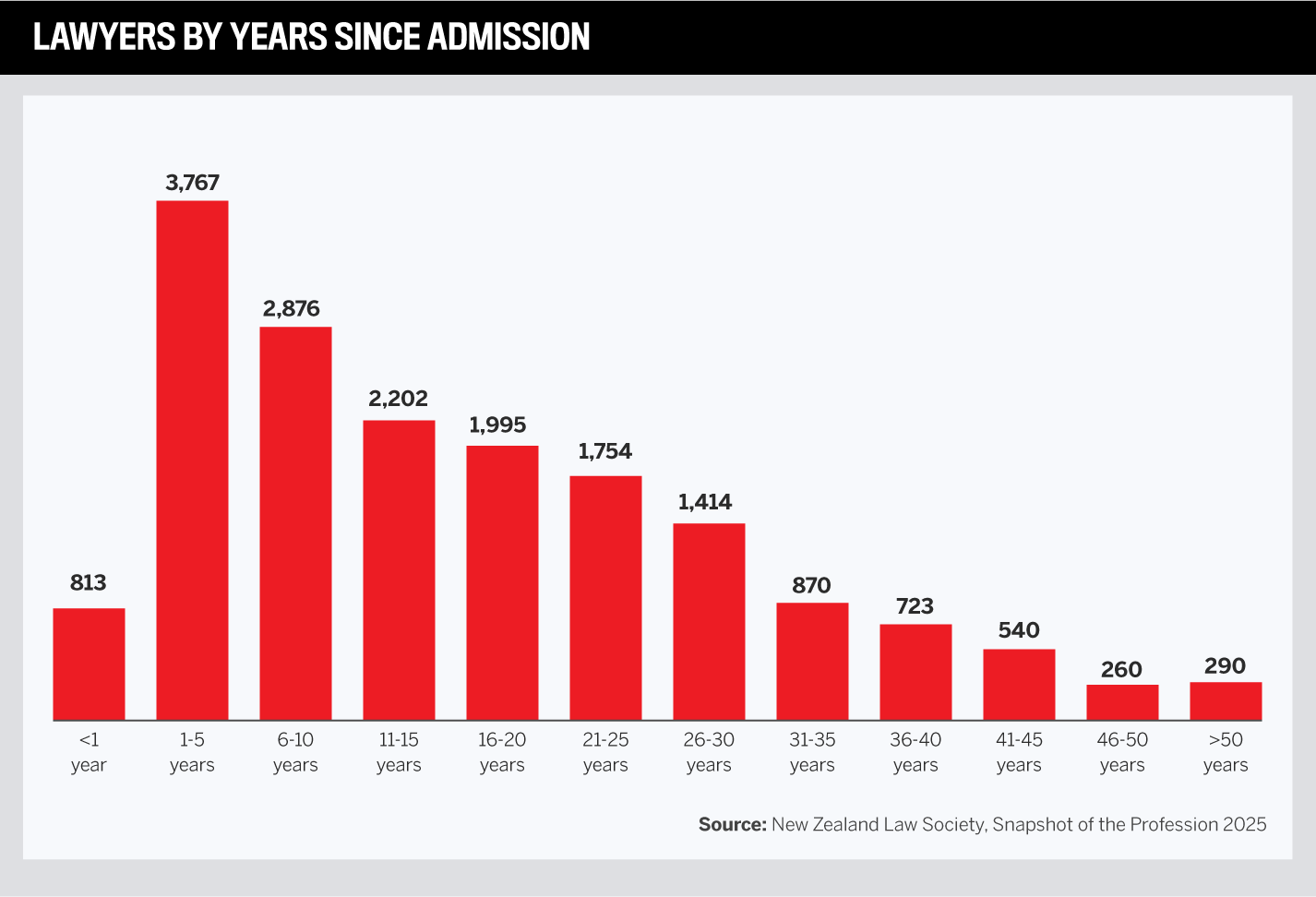

New Zealand Law Society’s data shows that the 0–7 years post-qualification experience (PQE) population reflects greater numbers of lawyers who identify as Chinese, Indian and other Asian nationals than their more legally experienced counterparts. More lawyers in the 0–7 PQE group identify as Māori, with 10.4% for 0–7 PQE, compared to 7.8% for all lawyers. A similar trend is observed among Pacific lawyers (Cook Island Māori, Fijian, Niuean, Samoan, Tokelauan, Tongan and other Pacific peoples).
“Broadly speaking, new lawyer cohorts tend to reflect greater diversity in terms of gender and ethnicity than their more experienced counterparts. This is significant because a strong legal profession should reflect the community that it serves,” says Katie Rusbatch, New Zealand Law Society chief executive. “As well as strong technical foundations, what really helps younger lawyers stand out is curiosity and a willingness to learn. Strong communication skills, an ability to navigate complex situations, and resilience and emotional intelligence are important.”
Analysing all the winners’ attributes reveals a series of skills that have enabled the group to innovate and carve out stellar reputations.
1. Deep client understanding and embedding in the business
Almost all of the Future Legal Leaders innovate by knowing the client unusually well.
They don’t just react to instructions; they learn the client’s strategy, risk appetite, commercial drivers and internal constraints, then design their service model around that. Examples are:
secondments or quasi secondments so they can “think like part of the organisation” and act early, not just at the end of the pipeline
local presence or community embedding (e.g., working in clients’ own languages)
Shared ability: The Future Legal Leaders are extremely good at context gathering – reading the organisation (or community) as a system, not just a matter file. That context then powers everything else they do.
2. Turning complex law into simple, actionable pathways
A huge, consistent pattern is translation – complexity to clarity.
The Future Legal Leaders make innovation real, not just through ideas but through communication:
visuals, templates and structured formats – tables, diagrams, checklists, flowcharts and step-by-step pathways
breaking legal journeys into manageable steps for unsophisticated users
Shared ability: They think like service designers and educators as much as lawyers, asking, “How does this feel from the client’s side, and what structure would make this easy to use?”
3. Process, systems and product innovation
A striking commonality: many of the Future Legal Leaders innovate at the level of process and legal products.
They aren’t just giving better advice; they are changing how the advice is produced, delivered and reused:
building tools and products: templates, standardised documents, precedents, checklists and playbooks
workflow and capacity systems: teamwide workflow boards, reporting and role design
Shared ability: They think like operators and product managers, asking, “How do we build a repeatable system that makes our whole team better and improves the predictability, speed and quality of our service?”
4. Smart use of technology and AI, but always in service of value
Many of the Future Legal Leaders are early and thoughtful adopters of tech, especially AI, but their approach is framed around client benefit.
Patterns include:
piloting and integrating AI tools
using tech for workflow and client transparency
combining tech with governance and policy awareness
Shared ability: They are comfortable experimenting with tech, but disciplined about where it actually moves the needle rather than than deploying tech for tech’s sake.

5. Commercial acumen and outcome orientation
Innovation is continually tied to commercial outcomes, not abstract legal neatness.
Consistent themes:
framing advice through a commercial lens: weighing risk versus operational reality, revenue, timelines and stakeholder relationships
building structures that create measurable value – price uplifts, reduced negotiation cycles, faster project delivery, new revenue streams
being explicit about timelines, cost, and scope
Shared ability: The Future Legal Leaders think and talk in business terms. They can connect legal strategy to financial, operational and reputational impact.
6. Relationship building, empathy and psychological safety as infrastructure
Soft skills are not incidental – they are core infrastructure for innovation.
Common patterns:
a warm, personable, calm demeanour that lowers client stress and encourages honesty
deliberate focus on psychological safety and inclusiveness
face to face and community-based relationship building
Shared ability: The Future Legal Leaders have high emotional intelligence; they understand that trust, safety and rapport are prerequisites for candid instructions, early escalation of issues and true partnership – all of which make innovative models work
7. Commitment to learning, collaboration and thought leadership
Finally, the Future Legal Leaders treat innovation not as a one-off project but as a continuous practice involving:
active industry engagement, conferences and training
internal capability building and mentoring
thought leadership and content creation
Shared ability: Curiosity and teaching orientation. Instead of just adopting better ways of working, the Future Legal Leaders codify, share and normalise them so the baseline of the whole team or industry rises.

As a senior associate in Maddock's technology practice, Darrell Choong has built a reputation where many lawyers still feel out of their depth, at the intersection of complex technology, high-stakes procurement and demanding stakeholders.
Over the past year, he seized a career-defining opportunity: a secondment to a large ASX-listed financial institution. The role was fast-paced, transaction-driven and required quick turnarounds.
Choong says, “It gave me the ability to see new perspectives on providing commercial legal advice to in-house teams and build on my knowledge around working with clients.”
Rather than simply keeping his head above water, Choong treated the experience as a live test of his Maddocks training. He leaned hard on being clear and proactive in all communications, being transparent and setting expectations ahead of deadlines.
“It was a particularly rewarding experience because we have since worked on matters directly due to the relationships that I forged during my secondment,” he says. “My time working in the team has enabled me to advise the client better on their projects.”
For Choong, effective lawyering starts with understanding the client in the round by knowing their business, priorities, decision makers and outcomes they are trying to achieve. That means combining subject-matter depth with a ‘team first’ mindset and guiding clients towards the most appropriate commercial outcome.
He adds, “Knowing the client’s business and people allows you to provide practical, outcome-focused advice, while trusted relationships and collaborative working styles enable you to deliver those outcomes effectively.”
Choong attributes his rapid development to a willingness to step into the unknown by being open-minded, working with new clients and teams, and on matters outside his immediate expertise. The team at Maddocks has also accelerated that growth.
“I am also fortunate to work in a highly collaborative and supportive team with some fantastic lawyers and partners around me,” says Choong. “I work very closely with partners who have entrusted me to step up in my career and actively looked for opportunities to challenge my development on multiple fronts.”
That type of support is something he has taken on himself becoming part of the New South Wales Law Society’s Mentoring Programs to support junior lawyers and law students as they navigate their early careers. He is also involved in subcommittee work within Maddocks’ technology practice in the people and mentorship committee.
“Through these experiences, I’ve learned the importance of patience and empathy and understanding that there are different ways of working and leadership.”
In the short term, Choong is focused on stepping up as a strong second-in-charge within his partner’s practice. Longer term, it’s about deepening expertise.
He explains, “I’m focused on deepening my expertise across key areas of my practice, continuing to broaden my skill set, and taking on greater responsibility in client relationships and matter leadership.”


The case that captures Choong’s approach
One matter neatly encapsulates Choong’s mix of technical judgment, pragmatism and stakeholder savvy: advising a state-owned corporation on the renewal of a critical workforce rostering software platform.
Working to very tight timeframe ahead of a fixed go-live date, he guided the client through a shift from legacy, state-mandated procurement contracts into the current mandated framework.
“I worked closely with the client to balance legal and commercial risk, while negotiating pragmatically with the supplier to achieve a timely renewal and contract uplift,” says Choong. “The outcome was a renewed agreement with strategically chosen uplifts for the client, achieved through close collaboration with the general counsel and the commercial and procurement teams.”
Crucially, the engagement allowed Choong to apply and demonstrate strong technical judgment around future-proofing technology arrangements – advising on the risk differences between legacy and current templates, and mapping future contracting pathways.
As founder of Infinity Solicitors, Vicky Peng has built a practice and reputation by handling cross-border disputes and highly regulated financial services work.
“As a commercial lawyer, I see my role primarily as a problem-solver. It is not just about winning or losing, but about understanding the client’s objectives, managing risk and achieving the best possible outcome in a practical and commercially sensible way,” she says.
Peng’s approach to lawyering is deeply informed by her engineering background. It trained her to break down complex problems, identify key variables and work towards efficient outcomes – a mode of thinking she now applies to commercial disputes and regulatory mandates.
This was shown in the last year by how she assisted an overseas listed company to invest in financial services, a highly regulated area of Australian law. It was a complex and compliance-heavy engagement, requiring navigation of detailed regulatory requirements and close attention to legal risk.
Peng explains, “I worked closely with the client to translate Australian regulatory requirements into clear, practical steps, ensuring they understood both their obligations and the commercial implications.”
Her rapid development has been driven by early responsibility and entrepreneurship. In a previous role at a boutique commercial firm, she gained direct exposure to clients and responsibility and accountability as a junior, which sharpened her judgment and sense of impact. Founding Infinity Solicitors then forced her to assume even more responsibility.
Leadership, for Peng, is something she exercises daily by setting direction, mentoring junior staff, building structured processes and improving workflow efficiency using technology, while remaining mindful of compliance risks. She says, “Balancing my roles as a lawyer, business owner, mother, wife and daughter has strengthened my ability to prioritise, adapt and stay focused under pressure.”
Looking ahead, she is focused on scaling Infinity in a sustainable and considered way, maintaining quality and supervision while exploring emerging technologies, particularly AI.
“I see both opportunities and risks in this space, from improving internal efficiency to navigating new regulatory and compliance issues for clients,” adds Peng. “I am actively exploring how these developments can be integrated into our practice, while also advising clients on the risks and obligations that arise from them.”

The case that captures Peng’s approach
A Supreme Court proceeding defined Peng’s year and also encapsulated her as a lawyer. Acting for a high-profile international client in a document-heavy, cross-border commercial dispute with allegations of fraud, she led a lean team with junior counsel and King’s Counsel, coordinating the matter end-to-end.
“The role required strong organisation and clear strategic oversight, particularly in managing a large volume of evidence and keeping the matter on track under tight timelines,” she says.
She bridged the gap between the client and the counsel by translating complex litigation strategy into clear, practical advice. Under significant pressure in the lead-up to and during the two-week trial, Peng maintained continuity in the conduct of the case and worked closely with counsel to steer its strategic direction.
Peng adds, “The proceeding ultimately resulted in a successful outcome for the client, reinforcing my ability to manage complex disputes in a practical, client-focused way.”
As an in-house lawyer at Genesis, a leader in New Zealand’s energy sector, Anna Coppage has built a career at the front line of change, such as negotiating upstream gas deals that literally keep the nation's lights on.
Unlike many of her peers, Coppage did not follow the traditional clerkship pathway. She mentors university students, who worry that missing out on the summer internship or the attachment with the large top firms will derail their careers, and reassures them that a career in law follows many paths.
Her differentiator is not chasing technical perfection for its own sake, but recognising that law is, at heart, a service industry.
“People come to us to solve their problems, and we are there to assist them and find a way through,” she says, pushing back on the profession’s ‘ivory tower’ stereotype. “Our successes are as much about the delivery of exceptional advice, but also advice that lands and that actually gets the outcome that your client wants.”
Having never worked in private practice, Coppage has learned her strategic advantage isn’t producing the perfect written opinion.
She says, “In some areas of the law, yes, that is absolutely what should be done. But I’m not in that world as most of the time, I work with a full range of stakeholders.”
Coppage has quietly built senior-level judgment by stepping into governance roles and steering committees, treating them as a live masterclass in how boards think. Sitting in those rooms has enabled her to observe how they problem solve, how they ask questions, what they pay attention to – all insights she uses to tailor advice.
“It’s invaluable knowing how different stakeholders think and how to then adjust your advice. The content can still be the same, but the way it’s delivered will be the difference between whether it’s accepted or not,” she says.
The energy industry has become both her professional home and motivation. She relishes working on transactions where the degrees of separation are short, for example, writing a contract to secure gas supply. Compared to her past roles in professional services, there has been a step change in impact as Coppage has gone from tweaking tax terms to "doing a deal to keep the lights on for the country".
The recognition as a Future Legal Leader is her first award and she speaks of being grateful for the “affirmation of the work done to date,” and views it as confirmation that a nonlinear path, built on soft skills and real-world outcomes, can still lead to the top.
“I do lots of other things and I don’t want to just be known as the lawyer. Of course, being successful as a lawyer is really important to me, but it’s not everything.”

The case that captures Coppage’s approach
A recent strategic joint venture (JV) dissolution showcases Coppage at her best. Typically, when a JV unravels, parties are not on good terms, with the aim being to go their separate ways and avoid dispute.
In this case, she helped steer the unwinding so effectively that, despite the transaction’s sensitivity and publicity, the parties remained connected. Several senior figures have since moved into new roles across the industry, yet there is still a willingness as people to work together.
“We were able to build a relationship that separated the people from the work,” says Coppage.
This ethos is how Coppage preserves long-term relationships in a context where clients are often not happy. It’s a concise illustration of what defines her as a lawyer: measured conduct under pressure, a focus on outcomes over ego, and pragmatism to turn even the end of a deal into the start of future collaboration.
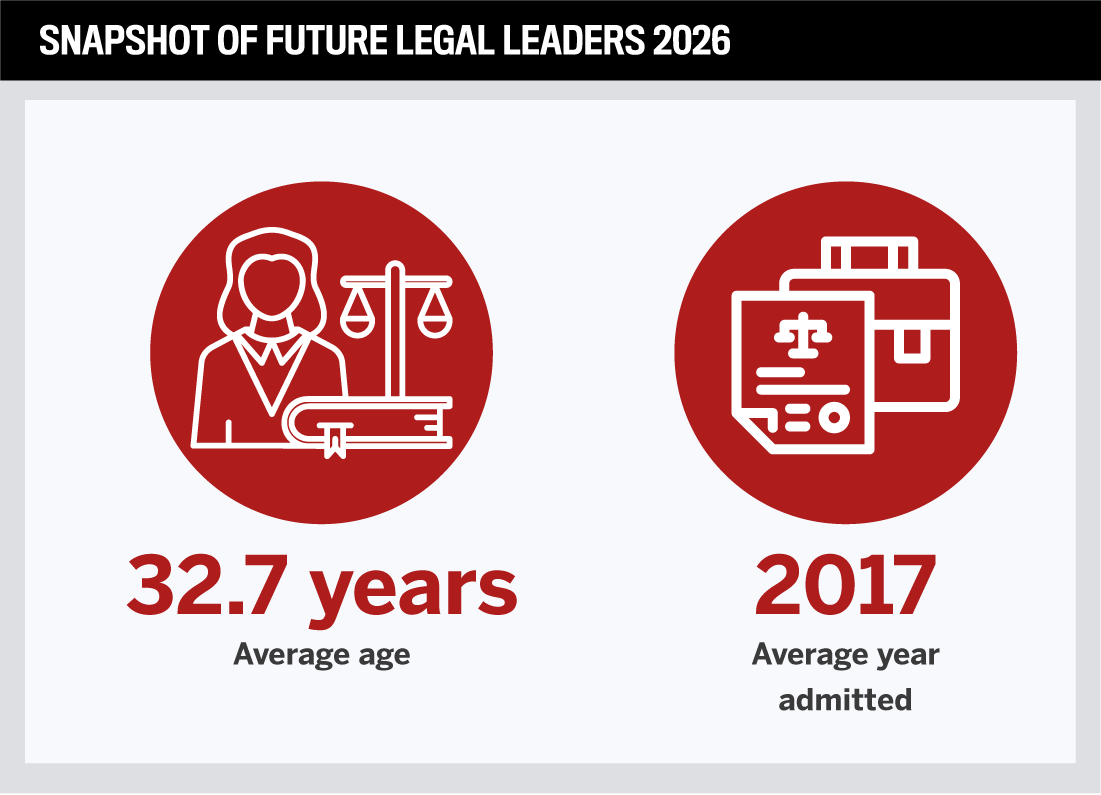















Last November, Australasian Lawyer and NZ Lawyer accepted nominations for the 2026 Future Legal Leaders (previously Rising Stars). The standout young stars from the Australian and New Zealand legal profession were invited to put their names forward; those who knew of and wished to highlight such talent were also asked to submit nominations.
Nominees needed to be 35 or younger as of 31 March 2026. They had to have committed to a career in the legal profession and shown a clear passion for the industry. The team also required nominees to cite their current position, responsibilities and key achievements over the past 12 months.
The team considered recommendations from managers and senior industry professionals in the review process conducted after the nomination period. After considering all aspects of the many submissions received, 72 emerged as the brightest young stars of the batch.
